← Back to resources
Blog
Born Smart: How to Connect Every EV to a Grid That's Already Full

Written by
Nick Woolley
Published
Letting every device onto the system works at scale, because the aggregate becomes firm and measurable. At the feeder, where diversity breaks down, it does not. Nick Woolley, CEO of ev.energy, makes the case for flexible connections: enforce the constraint rather than estimate it, with no compromise for drivers.
The law of small numbers is the real enemy
Network planners size a feeder using After Diversity Maximum Demand (ADMD): the per-customer peak assumed once accounting for the fact that not everyone peaks at once. Across ten thousand homes, diversity is reliable, and the per-customer number is low and trustworthy.
ADMD has an unfortunate property, though. It climbs steeply as customer numbers fall. Ten homes do not diversify like ten thousand. Whether three of them or none draw heavily at 6pm on a given evening is close to a coin toss, and a transformer rating cannot be built on a coin toss. So the planner sizes the asset for a worst case that, on almost every actual night, never arrives.
Now add EVs. An unmanaged 7 kW charger is not a small, well-behaved load. It is large and correlated; everyone plugs in when they get home. Correlation is precisely what destroys diversity, and at small N there is no large-population smoothing to rescue you. A recent Pacific Northwest National Laboratory study puts numbers on it: EV chargers on a feeder stay highly stochastic until hundreds to thousands of devices are connected, and only behave near-deterministically at 500 to 2,000-plus. A residential service transformer serves five to ten homes. Those numbers will never appear there.
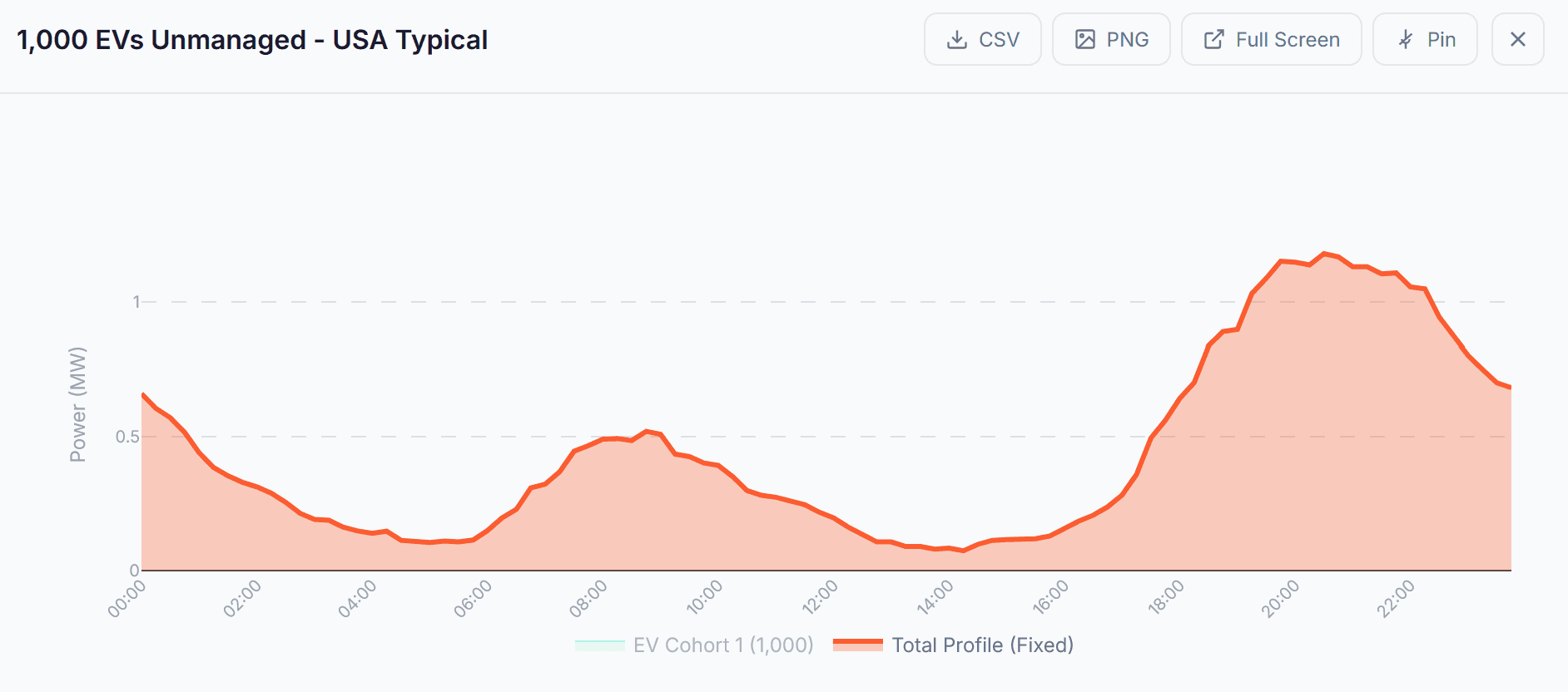
1,000 EVs left unmanaged will deliver about 1.2 MW at peak, under typical conditions.
Scale up, and the picture tightens dramatically. Eve Insight, modelling from millions of managed charging sessions, puts 1,000 unmanaged EVs at about 1.2 MW at peak — around 1.2 kW per vehicle, within a 95% confidence interval of 1.02 to 1.35 MW.
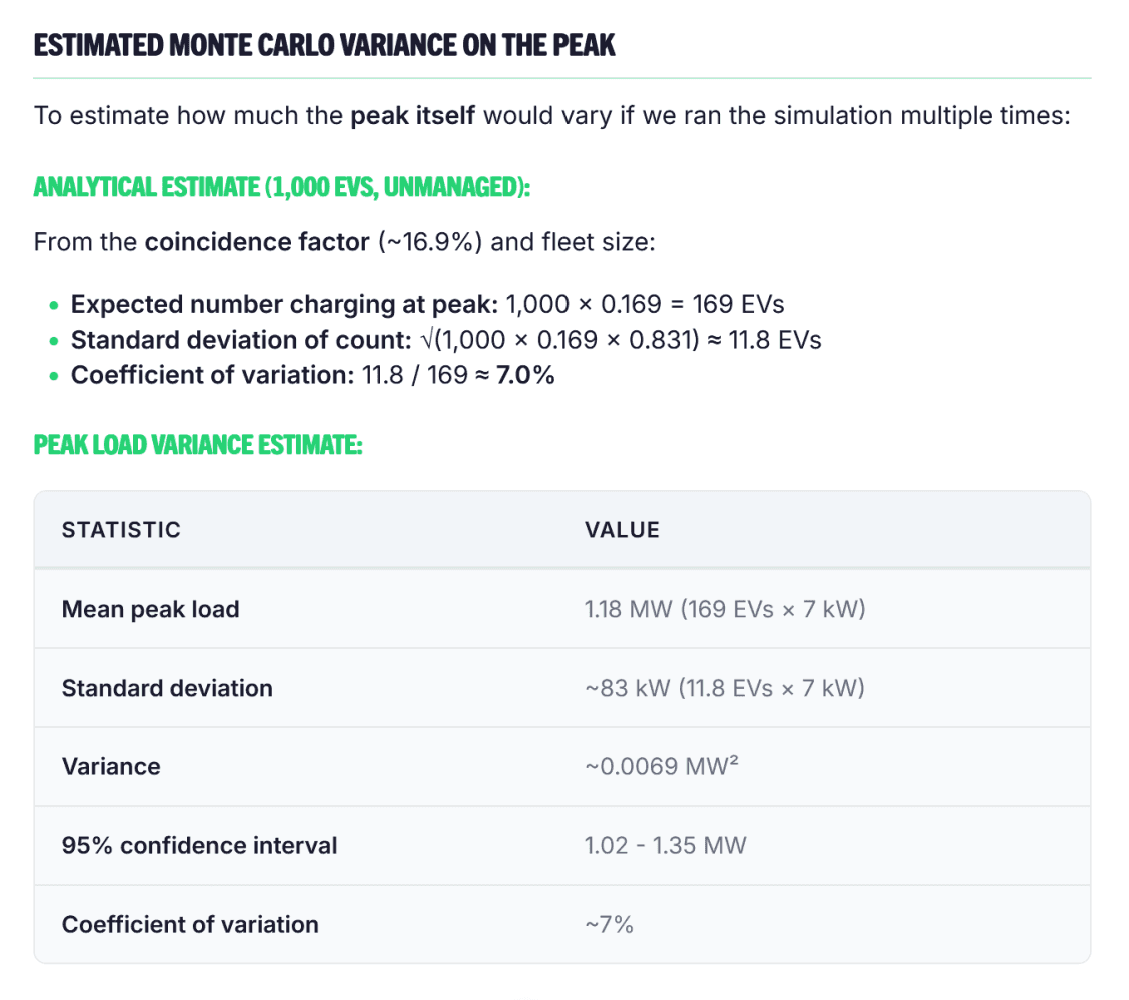
The 95% confidence interval of the 1,000-EV peak is 1.02 MW to 1.35 MW.
These are modelled values, and exact numbers vary by geography and feeder configuration. The asymmetry is the point. The peak of a thousand vehicles can be estimated with high confidence; the peak of ten cannot be estimated with any confidence at all. So today the choice is to over-build for a peak that rarely comes, or leave the driver in an interconnection queue. Both are bad and avoidable.
Stop estimating the peak. Manage it.
If the diversified peak of ten vehicles cannot be reliably estimated, the answer is to stop estimating it and enforce it instead.
That is what a flexible connection does. The connection carries a standing condition: draw whatever you like, whenever you like, provided the total at this constraint point never exceeds its limit. The spiky, unknowable ADMD of ten vehicles stops being a random variable to plan around and becomes a controlled quantity. The law of small numbers is made irrelevant.
There is precedent. British distribution system operators already issue flexible connection agreements to generators and large loads, trading firm capacity for managed capacity to skip the reinforcement queue, and solar did a version of it through IEEE 1547. What is new is pushing that logic down to the residential EV, at a scale only orchestration makes possible.
It also sidesteps the debate over accrediting voluntary flexibility as dependable capacity. If overload is prevented at the point of connection, there is no probabilistic reduction to prove, because the constraint cannot form.
Managing the peak can deliver a delightful customer experience
A flexible connection shapes when energy is delivered. It does not cap how much, and a driver can connect without waiting for the network to be upgraded.
Drivers rarely care about timing, provided the car is full when it is needed. Everything between plug-in and departure is slack, and slack is great for the grid. A vehicle plugged in at 6pm and leaving at 7am has thirteen hours to absorb a charge that takes four, which can be shifted, while a driver who needs to charge immediately can override smart control.
Nothing is given up. The driver’s need and the grid’s limit are not in competition. Both are satisfied out of the same thirteen hours.
Smart when it’s connected, flexible when the market needs it
There is a second consequence, and it ties this back to how flexibility actually gets sold.
A smart-connected EV has committed to staying under the feeder limit during constrained hours, which makes it contractually absent from the early-evening peak, and capacity a resource is obligated to withhold is not capacity it can sell. Counting the connection-driven avoidance and bidding the same hours into a market is double-counting, and a serious market operator will catch it.
The legitimate bid is what remains once the constraint is honored: for a managed EV, the overnight and daytime trough. That is a feature, not a loss. Baseline gaming is the oldest problem in demand-side markets, and a baseline enforced by a connection agreement rather than estimated from a contestable counterfactual is one a market can actually trust. The flexibility that does get sold becomes more bankable, not less.
Two products, two regulatory boxes, one asset, and no double-counting. Smart when it is connected. Flexible when, and only when, it truly has flexibility to sell.
The impact on one real feeder with five homes and five vehicles
Take a feeder serving five homes, with a combined load of just over 60 kW.
Peak coincidence at five unmanaged EVs runs 5–10%, so on roughly one evening in ten they charge together: a 35 kW EV peak, over 50% of new load, pushing the feeder to almost 100 kW. There is no diversity to soften it at five vehicles, so the coincident spike is real and harmful. The planning model calls for reinforcement.
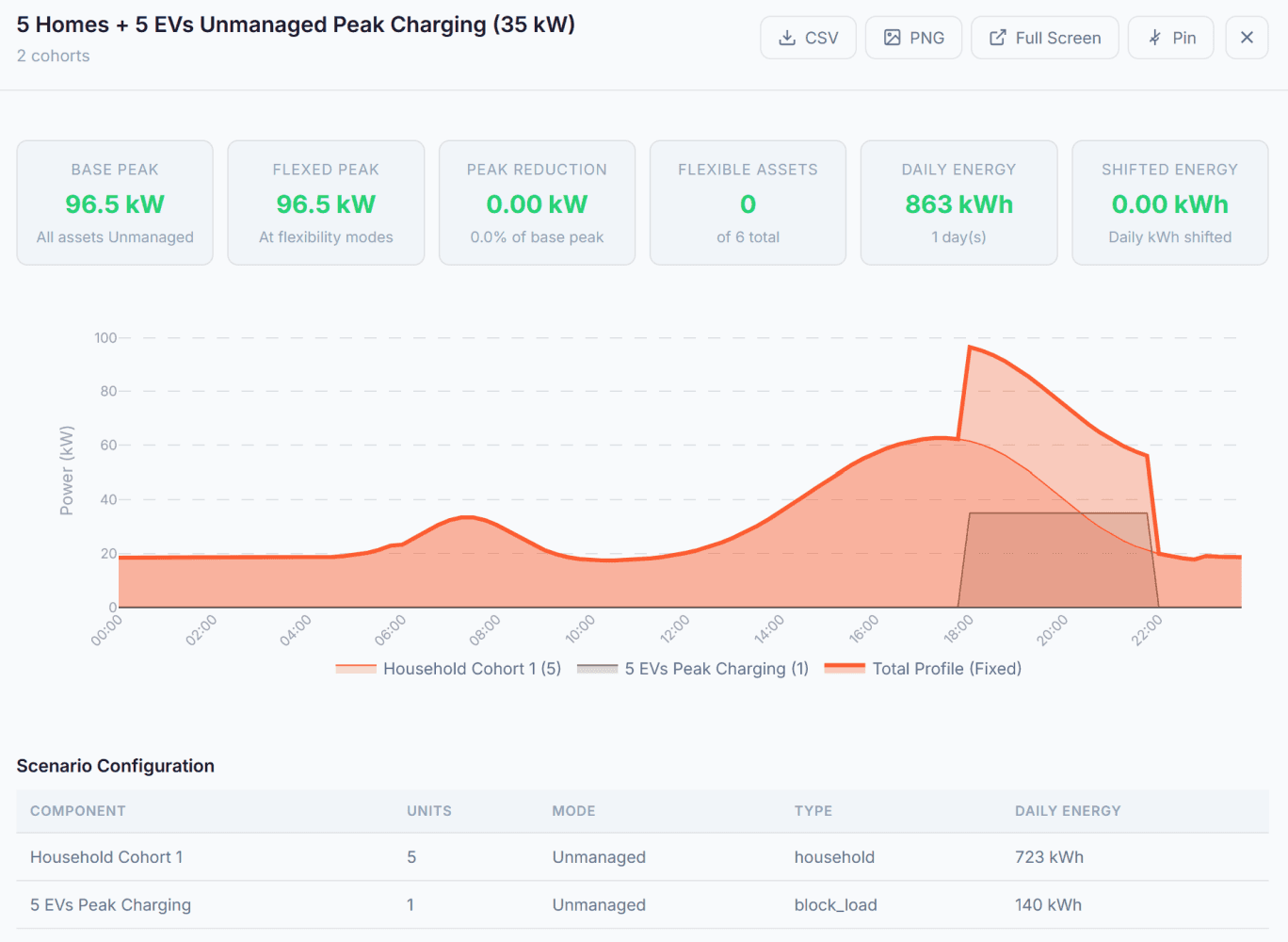
5 homes and 5 EVs all charging during peak hours create a feeder that peaks in the early evening.
Now connect the same five EVs with smart charging from day zero. Same vehicles, same total energy delivered, and every car still full by the exact departure time its driver needs. Not less charge. Not a slower charge anyone would notice. The same charge, arranged in time. Orchestration shifts each session into headroom the feeder already has, so the aggregate rides just under the constraint line all night, like water finding its level. Five drivers wake up to full batteries. The feeder is never breached.
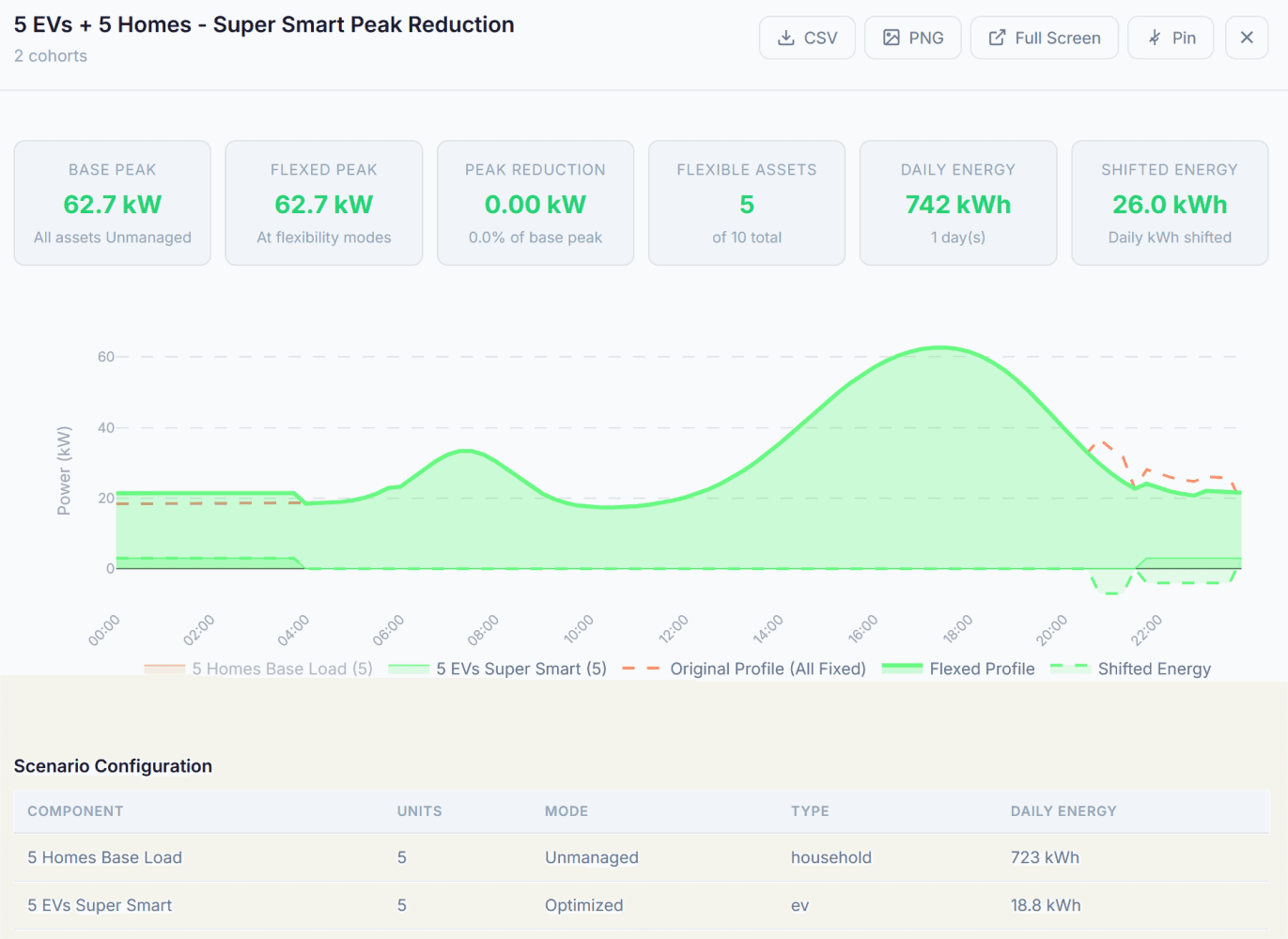
Managing 5 vehicles and 5 homes with optimization enables everyone to get a full charge on one feeder.
A 50% increase in peak loading, absorbed with no reinforcement and no impact whatsoever on the customer’s requirements.
The regulators are already writing this down
The encouraging part is how fast policy is converging.
New Jersey’s BPU virtual power plant straw proposal reads almost like a flexible connection agreement for aggregations: interim programs for 2027 to 2029, a long-term framework to follow, and a target defined by a goal (a 3% peak demand reduction, in this case) rather than by a favored technology.
California is moving compatibly, and its distribution studies price the prize: flexibility that respects local feeder limits delivers roughly $1.8 billion in avoided distribution costs through 2040, against about $150 million when the same flexibility only chases bulk-system signals. More than ten to one, and the entire gap is locational orchestration, managing to the constraint, not to the average.
Research points one way. Regulation points the same way.
A flexible connection standard is not a proprietary protocol
A flexible connection standard has to be open, interoperable, and capable of being met by any competent platform. The moment it becomes “connect through this one company,” it stops being good policy and becomes a land-grab, and a regulator is right to reject it. Define the outcome, prove the limit is respected, and let orchestration handle the how.
Leveraging flexibility to avoid building for the peak
For a century, the grid was sized around the worst thing every load could do, because at the edge, where diversity fails, there was no way to know what it actually would do. Now, managed charging is already at scale with utilities and CCAs including Con Edison, National Grid, and MCE.
So every device can be let in, even onto a feeder that looks full, because the peak of those ten vehicles is no longer a number to estimate and fear. It is a limit to set and stay under, without a single driver getting less than the full charge they needed. Then, what is left over once both the driver’s need and the grid’s limit are met, is the only flexibility that should ever have been sold into a market in the first place.
How much distribution capacity could a flexible connection release on your network? Don’t wait months or years to find out. Model your own feeder scenario in minutes with Eve Insight. Book a demo today →
Sources
Pacific Northwest National Laboratory, Distribution Operational Potential of Grid Edge Resources, PNNL-39320, May 2026.
IEEE Standard 1547, Standard for Interconnection and Interoperability of Distributed Energy Resources with Associated Electric Power Systems Interfaces.
New Jersey Board of Public Utilities, Virtual Power Plant Straw Proposal.
California IOU distribution and electrification impact studies (PG&E EIS Part 2 and related CPUC filings).

